
2026+
A Wishful Thinking List

I wrote about the past year, now let me dream about the future. Short-term, for the next year or slightly beyond. I think my list is somewhat overoptimistic, so consider it my wishful thinking list if you will.
🤖 Physical Robots
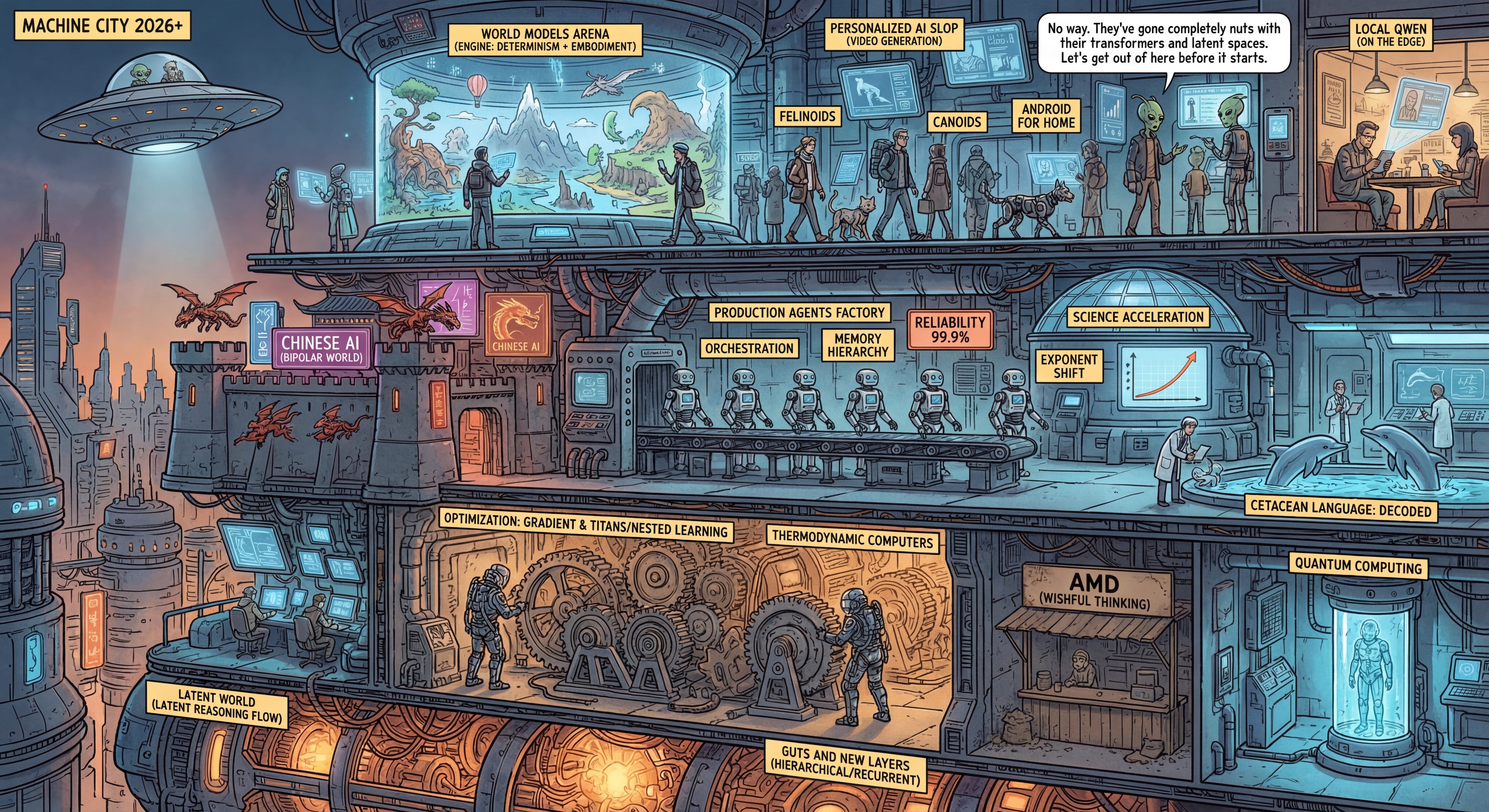
Wheeled delivery robots have been doing well for ages (we were in the Berkeley SkyDeck accelerator back in 2017-18 in the same batch as Kiwibot, whose machines were rolling around the city quite successfully and making eyes at passersby, and now this surprises no one). But there are also humanoids and various quadrupeds. For them, quantity will start transitioning to quality. A humanoid for the home will remain too expensive a toy, but a felinoid or canine-like robot (caninoid?) could become quite reasonable.
🌍 World Models
They’ll gradually start outperforming traditional approaches in practice in specific domains. There will be some absolutely spectacular research demonstrations with groundwork for interactive worlds of a new type, in games or other entertainment. Some engine will emerge combining classical determinism with neural generation (something like this as a PoC?). I expect a parallel branch within world models to develop, built not on LLMs or some other Foundation Model from top-down, but growing bottom-up through embodiment.
🔬 Accelerating Science
Somewhere beyond pure computer science, the first stable results will appear for accelerating some part of the scientific process, such that it will manifest in a shift of the exponential curve for those who master it. Perhaps it’s already appeared—I wouldn’t be surprised.
🐋 Animal Language
We’ll make progress in understanding one of the animal languages. Most likely with cetaceans—there were already interesting results last year (they found analogues of vowels and diphthongs in sperm whale communication)—but possibly with someone else, for example, corvids. It’s too early to talk about bidirectional interaction.
🐉 Chinese AI
They’ll keep pushing forward and advancing their hardware. Generally, I’m increasingly reminded of the conditionally bipolar east-west world from the film The Creator. Not that it’s a particularly good film, but I think they captured something correctly. This isn’t really about the film, but listen to poets—they begin catching the essence of things earlier than others. That’s usually why the powers that be persecute them.
⚙️ Production-Level Agents with Three Nines
The year of reliable agents and rich integrations. We’ll learn better how to build agents with predictable quality and deploy them to production with 99.9% reliability. More developed infrastructure and tools will emerge. A fair number of large startups will appear around this ecosystem.
🧠 Cognitive Architectures
An old term, but it’s being revived and reborn. If at the production level there’s movement toward reliability, at the research and experimental frontier-application level there will be movement toward finding the right cognitive architectures for the task. Individual LLMs won’t compete with each other—commoditization has nearly happened for them—but rather systems with LLMs as one of the elements. Orchestration, memory hierarchy, goal decomposition and requirements control, feedback loops—the best developments will transfer to production.
👤 Agents for Ordinary Users
So far, all agents have mainly been for business, narrow circles like programmers, or demonstrations of capabilities impractical in practice. It’s time for agents to start appearing that work for the benefit of the average end user—solving their local day-to-day tasks for organizing affairs, purchases, logistics, working with information. Current GPT/Claude/Gemini can already do quite a lot in principle, especially with the right integrations, but there are still too many frictions.
🎬 Video Generation
Well, that’s it. Social networks and messengers will be flooded with AI slop, and it will even be personalized for you.
💻 Local Hardware
Running proper LLMs on the edge is nearly here. The spectrum ranges from home servers to laptops and phones, with models of different sizes, naturally. For me, the turning point will be when going to something like GPT becomes unnecessary—for most local tasks, a locally deployed Qwen or similar will suffice.
⚡️ Interesting Hardware
There will be interesting applications of non-conventional hardware like thermodynamic computers. There will be curious and diverse life beyond the NVIDIA ecosystem. Perhaps AMD will finally become a real alternative, though that’s really wishful thinking. They haven’t managed it in a decade.
⚛️ Quantum Computers
They’ll continue developing actively. They won’t help with neural networks yet, but will help with specific specialized tasks. It’s high time to study them. I’ve already started/continued. Combined with the fact that a hundred years after the emergence of quantum mechanics we know how it works at the mathematical level but still don’t know why exactly it all works the way it does (at least using the Copenhagen interpretation), this is particularly interesting.
🔮 Internals and the Latent World
There will be major movement in architecture regarding latent reasoning (in the broad sense). There will be more models explicitly working with latent space, which will result in improved tokenization or abandoning it altogether, more computationally efficient solutions, and interesting multimodal solutions. Possibly some new exotic types of layers will appear—I wouldn’t be surprised if they’re multi-level and hierarchical, combined with recurrence.
📈 Optimization
I wouldn’t be surprised if a new good gradient optimization algorithm appears. I think a breakthrough in understanding is brewing there. Beyond purely gradient methods, I expect a larger zoo and crossbreeding with evolution. I also expect development of the Titans/Nested Learning theme.
👽 Aliens
Extraterrestrials will look at all the chaos happening on Earth and decide not to make contact. No thanks.
That’s my list. In a year, we’ll see what came true and what remained wishful thinking. If you have your own predictions for 2026—share them, it’s interesting to compare forecasts.
I will extend this list with my list, but if I start by giving a recommendation:
Classical and Quantum Computation by Yu Kitaev Vyalyi
I loved this book.